

How an electric skateboard belt drive powers the rear wheels
How belt drive actually gets power to your rear wheels
Most riders assume an electric skateboard works like an electric scooter, with a motor tucked inside each wheel doing the spinning. That is not how it works. Evolve boards, and belt-driven electric skateboards generally, keep the motors mounted separately at the rear truck and use a toothed belt to transfer power to the wheel. Understanding that distinction actually explains a lot about how these boards ride, why maintenance matters, and what you are paying for when you step up to a premium deck.
The layout under the deck
Flip a board over and the first thing you notice is the battery enclosure running down the center of the underside, taking up most of the real estate. The trucks sit at either end, but they are not equal partners. The front truck just carries two free-rolling wheels, no motors, no belts, nothing driven about it. All the mechanical work happens at the rear truck, where two motors sit side by side, one dedicated to each rear wheel.
That is worth sitting with for a second. You have two independent drivetrains doing identical jobs on either side of the same axle, not one motor splitting power between both wheels. Each rear wheel gets its own motor, its own belt, and its own tensioning setup.
Following the power from motor to wheel
The actual path power takes is straightforward once you see it laid out. Power leaves the motor and turns a small toothed pulley fixed directly to the motor shaft. A toothed belt loops around that pulley and around a much larger drive gear mounted on the rear axle. The belt is what carries rotational force from the small motor pulley to the larger gear, and the size difference between the two is part of what determines how the board accelerates and climbs.
Here is the part riders often get wrong: the drive gear is not the wheel. It sits on the axle with raised lugs on its wheel-facing side, and when the wheel is slid onto the axle, those lugs engage matching spaces inside the wheel hub. That engagement is what makes the wheel actually turn with the gear. A wheel nut holds the whole assembly together on the axle. So the full chain looks like this: motor, motor pulley, belt, drive gear, wheel hub, wheel. Five handoffs before the road ever feels any of it.
Why belts instead of a direct or geared connection
Evolve boards use belt drive across the entire lineup, never a rigid gear-to-gear connection. A belt gives the system a small amount of give, which matters more than it sounds like it should. It allows the motor to be mounted slightly forward or backward of the drive gear rather than needing perfect axle alignment, and it tolerates the kind of vibration and shock that comes standard with riding pavement, potholes, and the occasional bad expansion joint.
The tradeoff is that belt tension becomes something you actually have to think about. Too tight, and the belt adds friction through the whole drivetrain, which can quietly eat into your range and put extra load on components over time. Too loose, and the belt can slip across the teeth of the drive gear under hard braking, which shows up as a loud clicking sound right when you are trying to slow down. Correct tension sits in a narrow window, roughly 5 mm of play in the belt with the wheel still spinning freely. It is a small detail, but it is the difference between a board that feels tight and confident and one that feels vague underfoot.
What this means when you are choosing a board
Once you understand that each rear wheel has its own motor and belt, the spec sheet starts making more sense. A board listing dual motors at higher wattage is not just quoting a bigger number for marketing purposes. It means each of those two independent drivetrains is doing more work, which shows up as stronger acceleration and better hill performance, not just a higher top speed on paper.
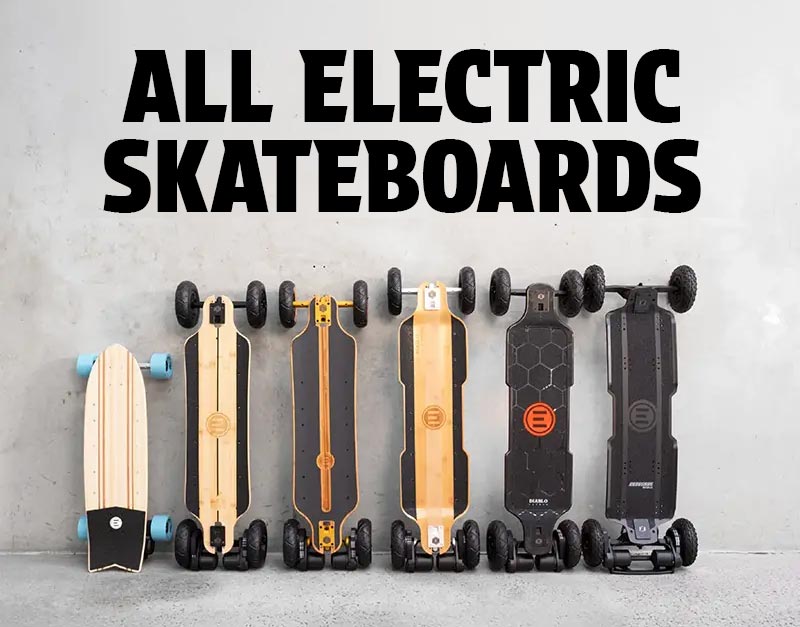
This is where a board like the Diablo Carbon Street earns its position at the top of the lineup. It runs dual 3500W motors, one per rear wheel, for 7000W combined, paired with an 864Wh battery that holds voltage under sustained load rather than sagging as the ride goes on. The forged carbon deck removes flex entirely from the equation, which means the power coming through those belts and drive gears gets translated directly into forward motion instead of getting absorbed by a deck that gives underfoot. At 29 lbs, it is also lighter than you would expect for a board built this solid, thanks to the carbon construction doing double duty as both structure and heatsink.
None of that changes the fundamental drivetrain layout. The Diablo Carbon Street still moves power through the same motor-to-pulley-to-belt-to-gear-to-hub chain as every other belt-driven Evolve board. What changes is how much power is moving through that chain and how efficiently the deck lets you use it.
Where this actually shows up on a ride
This matters more in some cities than others. Climbing the hills around San Francisco or working through stop-and-go traffic in Los Angeles puts real, repeated load on the rear drivetrain, motor torque, belt tension, and drive gear engagement all working together every time you accelerate from a stop. Riders doing longer flat stretches in Miami or covering ground across Austin are leaning more on sustained motor output and range than on peak torque. New York riders dealing with potholes and uneven pavement are asking the belt system to tolerate a lot of small shocks without losing tension. In every case, the same basic drivetrain is doing the work, just under different demands.
The honest takeaway
Belt drive is not a compromise or an old-fashioned way of doing things. It is a deliberate design choice that gives Evolve boards flexibility in motor placement and tolerance for real-world riding conditions that a rigid direct-drive system would struggle to match. Once you understand that two independent motor-and-belt systems are doing the work at the rear truck, the whole board makes more sense, from why tension matters to why a heavier-duty setup like the Diablo Carbon Street rides the way it does. If you are the kind of rider who wants to feel exactly what a well-matched motor, belt, and deck combination is capable of, this is the version of that idea built with the least compromise attached to it.
-
Posted in
electric skateboard, evolve
