


The best places to ride, and how to find them near you

Where to actually ride an electric skateboard, and how to find your own spots
Most riders spend more time thinking about which board to buy than where they are going to ride it. That is backwards. The board matters, but the route is what determines whether every session feels like a chore or a reason to leave the house. A flat, smooth stretch with light traffic will make almost any electric skateboard feel great. A cracked, hilly street with stop signs every block will make even a well-built board feel like a compromise.
Finding good places to ride is less about discovering some secret list and more about learning what to look for, then applying that to your own city. Once you know the pattern, you start spotting rideable routes everywhere, including places you have driven past a hundred times without noticing them.
Surface quality changes everything
Asphalt condition affects an electric skateboard more than most riders expect. Cracks, seams and potholes do not just jolt your feet, they steal speed and range because the motors have to work harder to maintain momentum over rough ground. A smooth, recently paved road lets a board glide at a steady current draw. A chip-sealed road covered in tar snakes forces constant micro-corrections and drains the battery faster than the same distance on good pavement.
This is why experienced riders often prefer newer residential developments, bike paths and multi-use trails over older arterial roads. Bike paths in particular tend to be resurfaced more often than general traffic lanes, and they are built with fewer hard camber changes, which makes for a more predictable ride at speed.
Bike lanes and multi-use paths are the real backbone of good riding
Dedicated bike infrastructure is quietly the best thing that has happened to electric skateboarding in the last decade. Protected bike lanes give you a buffer from car traffic, a smoother surface than the main road, and a predictable line of travel that makes group rides and commutes far less stressful.
Cities investing in connected bike networks are, often by accident, building excellent skateboard routes. Los Angeles has expanded its river path and beach-adjacent bike routes considerably, and riders along the Marvin Braude Bike Trail from Santa Monica down to Redondo Beach get miles of flat, wide, mostly uninterrupted pavement with ocean views as a bonus. San Francisco is hillier and less forgiving, but the Embarcadero and the paths through Golden Gate Park offer flatter sections that reward riders willing to scout before committing to a route.
New York's greenway system, particularly the Hudson River Greenway on the west side of Manhattan, gives riders a long, mostly flat, car-free corridor that would be unthinkable to replicate on city streets. Austin's Lady Bird Lake trail and the network of paths feeding into it offer a similar experience with a different backdrop, and Miami's beachfront paths and the Underline beneath the Metrorail give riders a genuinely rideable alternative to the city's busier arterial roads.
None of these are secret. They show up on any basic map search for bike trails or multi-use paths in your area. The skill is in treating that search as your starting point for skateboard routes, not just cycling routes.
Hills are not the enemy, but they do dictate your setup
A hilly route is not automatically a bad route. It just requires a board that can handle it without straining. Evolve's boards are built with hill-climbing torque in mind, and dual motor setups in the 3,000W to 3,500W range per motor generally handle inclines up to 35 percent gradient or more without losing composure. If you are riding somewhere like the hills east of downtown Los Angeles, the steeper pockets of San Francisco, or the rolling terrain around Austin, that torque is the difference between a board that climbs confidently and one that bogs down and drains its battery fast on the way up.
The practical takeaway is to scout a route's elevation profile before you commit to it regularly, especially if you are riding a lower-power setup. A route with a few short climbs is fine. A route that climbs continuously in one direction will eat range on the way up and demand strong braking on the way down, which matters more for beginners than most first-time buyers realize.
Off-road riding is a genuinely different category, and it needs a different mindset
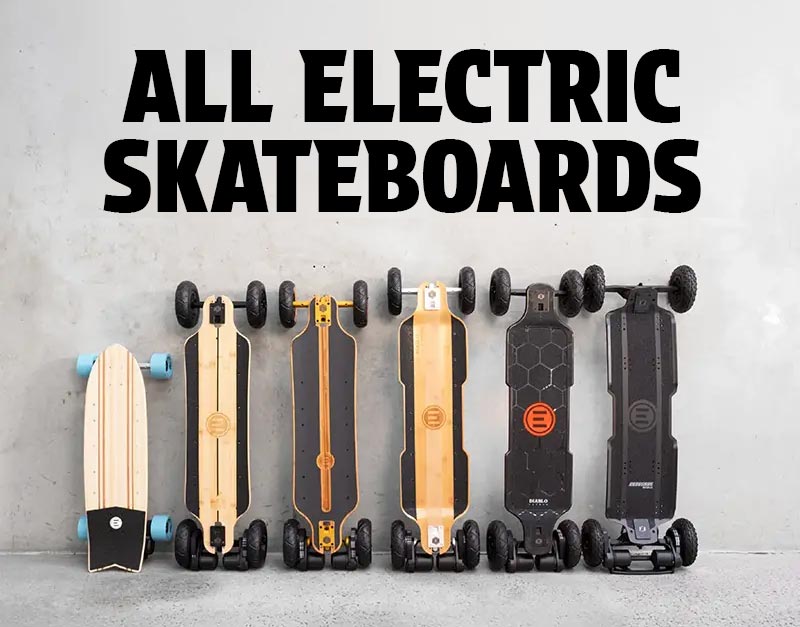
Searching for off-road electric skateboard riding usually means one of two things: gravel and dirt trails, or grass and unpaved parkland. Both require pneumatic tires rather than street wheels, because the rolling resistance and surface irregularity of unpaved ground will destroy the ride quality and shorten the life of a small urethane wheel. This is exactly why Evolve's all-terrain boards run 7-inch pneumatic tires instead of the 97mm street wheels used on our bamboo and carbon street decks. The larger tire absorbs terrain that would otherwise transmit straight into your legs.
Good off-road riding spots are less about famous trails and more about finding wide, packed-dirt fire roads, disused rail corridors converted to trail use, or grassy parkland with minimal foot traffic. These exist in almost every metro area, usually just outside the dense urban core. They are worth scouting on foot or by bike first, since surface conditions can change significantly after rain, and mud or soft sand will bog down even a capable all-terrain setup.
How to actually find new routes, rather than just hoping you stumble onto one
The most reliable method is layering a few free tools rather than relying on any single source. Start with a cycling-focused mapping app, since bike route data is more mature than skateboard-specific data and the surface concerns overlap closely. Cross-reference that with satellite imagery to check for path width and surface type, since a route can look perfect on a basic map and turn out to be a narrow dirt track in reality.
Local skate and longboard groups are also worth joining, even just to read rather than post. Riders who have covered the same ground already know which sections flood after rain, which intersections have bad sightlines, and which stretches get resurfaced or torn up. That local knowledge is worth more than any generic list of top ten spots, because it reflects current conditions rather than a snapshot from whenever an article was written.
If you are near Oceanside, California, the coastal paths and the harbor area offer a useful mix of flat cruising and rougher patches worth testing a board's range and stability on, and it is a route we know well from our own store nearby.
The honest take
There is no universal best place to ride an electric skateboard, only the best place to ride the way you actually ride. A commuter chasing a smooth, fast, predictable path wants a different route than someone chasing dirt trails on the weekend. What separates riders who love their board from riders who leave it in the garage is usually not the board at all. It is whether they took the time to actually find a route that suits it. Do that scouting once, properly, and every session after gets easier.
-
Posted in
electric skateboard, evolve
